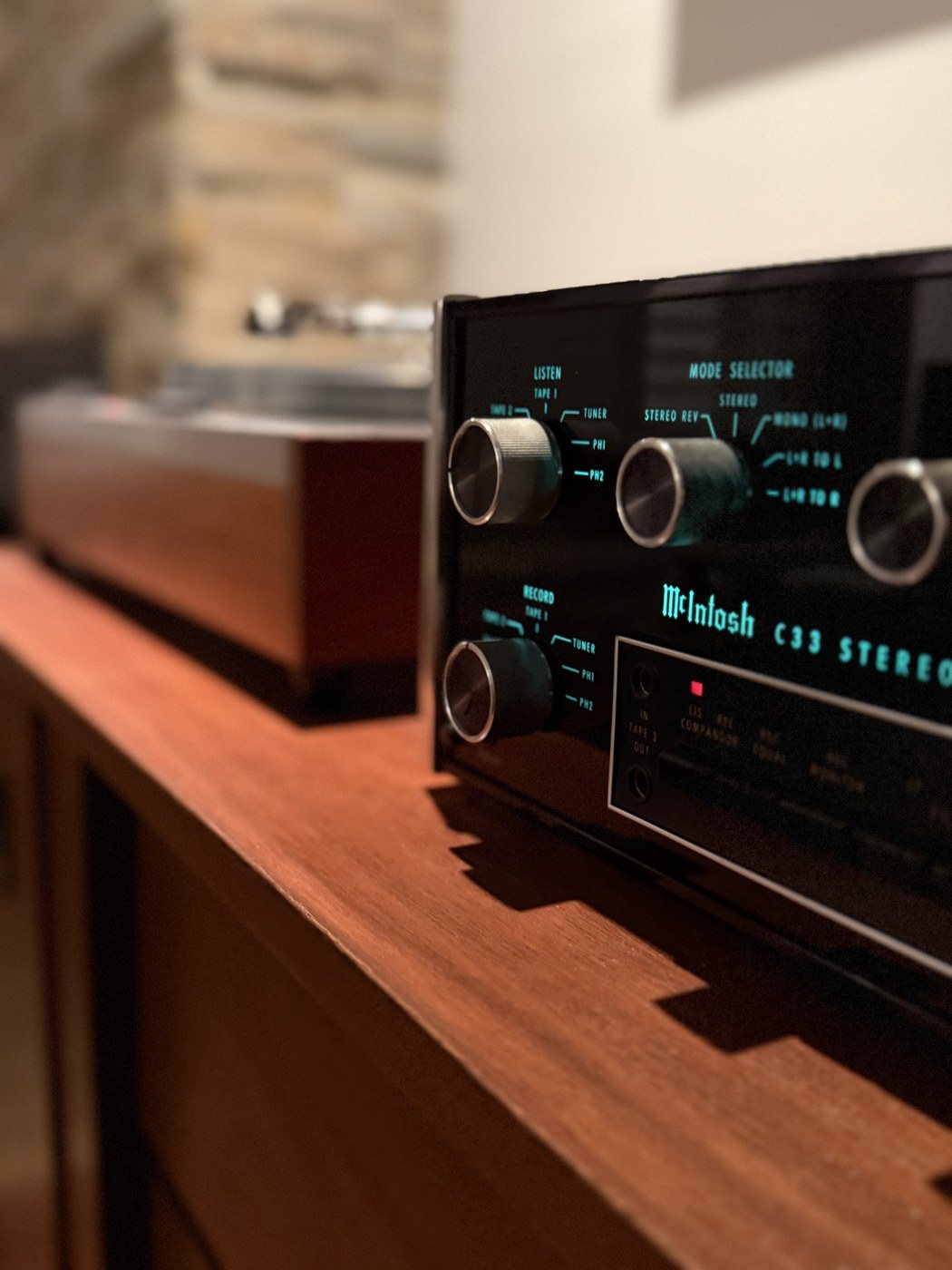
There is a particular kind of audio revelation that doesn't arrive with fanfare. It sneaks up on you during a quiet Saturday afternoon, when the music sounds better than it has any right to, and you realize the component responsible isn't the one you expected. That is exactly what happened when I connected my Klipsch Forte IV speakers directly to the monitor amplifier outputs of a vintage McIntosh C33 preamplifier.
I had not set out to find a new favourite amplifier. I had set out to satisfy a curiosity.
The Question Nobody Asks About the McIntosh C33
Every McIntosh C33 owner knows the unit contains a built-in 20-watt-per-channel Class A/B solid-state monitor amplifier. It appears in the specs, occupies a modest line in the owner's manual, and is almost universally used for headphone listening or near-field monitoring while dubbing tape. Nobody seriously discusses using it as a primary speaker amplifier. The forum threads don't exist. The comparisons haven't been made. It is, in the language of the audiophile community, a road not taken.
I decided to take it.
My reasoning was rooted in lived experience. For nearly two years, my daily driver was a Decware Zen UFO2 — a hand-built American single-ended triode producing 2.3 watts per channel. On the Klipsch Forte IV's 99dB sensitivity rating, that almost comically small amplifier filled rooms, conveyed dynamics, and delivered musical satisfaction I hadn't expected from something the size of a lunchbox. If 2.3 watts was enough, twenty watts represented an enormous reserve. The question was not whether the C33's monitor amp had sufficient power. The question was whether it had sufficient quality.
The answer, as it turns out, is yes — and then some.
McIntosh C33 Engineering: The Sweet Spot Between Two Eras
To understand why the C33 sounds the way it does, you need to understand where it sits in McIntosh's engineering history — because it occupies a position that was never repeated.
The company spent the 1960s and 1970s building preamplifiers around fully discrete transistor (TR) circuits — hand-selected, individually matched components assembled into bespoke gain stages. The McIntosh C26, C27, C28, C29: all TR designs with a sonic character that became synonymous with the McIntosh name — warm, harmonically rich, smooth in the midrange, with a slightly romantic, unhurried quality throughout. Beloved. But increasingly showing their measured limitations in noise floor and channel matching as the 1980s approached.
The C33, introduced in 1981, changed the fundamental architecture. It was McIntosh's first preamplifier to fully commit to integrated circuit (IC) op-amp design throughout the signal path. Lower noise floors. Tighter channel matching. Better distortion figures. More neutral, more accurate, more revealing than its TR predecessors. It launched an entirely new design generation that McIntosh carried forward through the C34V (1985–1992).
Then, in 1990, Clarion acquired McIntosh.
What followed was technically capable. Measured performance continued to improve. But a significant portion of the McIntosh community — engineers, long-term owners, reviewers — perceived a meaningful shift in voicing philosophy after the acquisition: products became more detailed, more analytical, more overtly "hi-fi" in character, and notably less smooth. Less ease. Less of the particular warmth and musicality the brand had always prioritized alongside its technical excellence.
The C33 and C34V sit precisely in the gap between those two worlds. IC precision, without the clinical edge that crept into post-Clarion products.
They are smoother and more musical than the TR designs that preceded them, and more accurate and controlled than those same TR designs. They were voiced entirely on McIntosh's own terms, by the original engineering culture, before commercial ownership priorities shifted the direction. That specific position in history is not incidental to how the C33 sounds. It is the explanation for it.
Klipsch Forte IV and the McIntosh C33 Monitor Amp: What I Heard
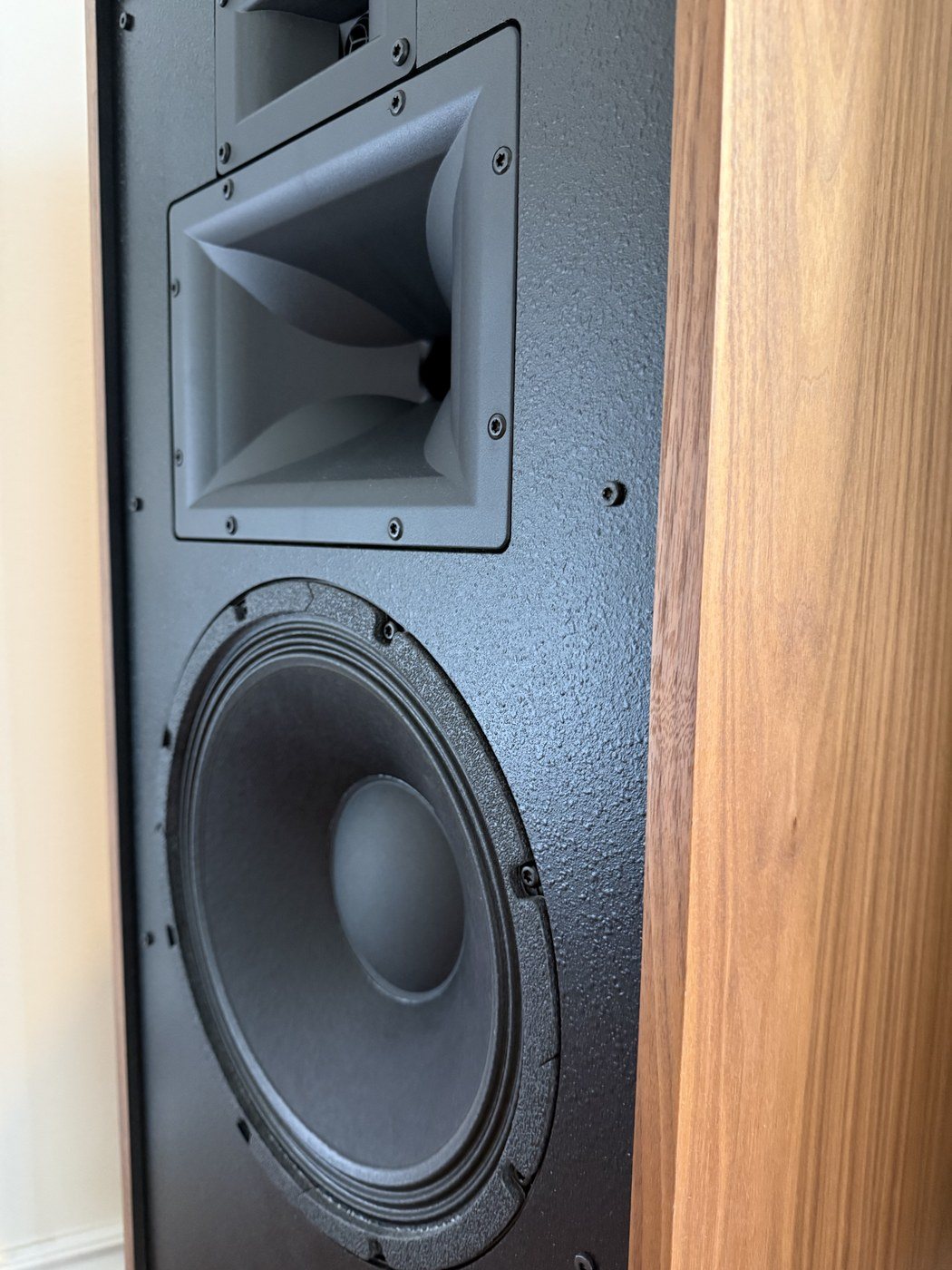
Connecting the Forte IVs to the C33's monitor amp outputs and pressing play for the first time produced an immediate reaction: this sounds right.
The presentation is smooth without being soft, sweet without being syrupy, and fast in a way that solid-state rarely achieves with horn-loaded speakers. The Forte IV's titanium tweeter and midrange horn are famously revealing — unforgiving of grain, hash, or electronic glare. The C33 produces none of those artifacts. What emerges is genuine transparency: instruments occupy distinct space, transients arrive cleanly, and the bass — frequently a weakness in low-powered pairings — is controlled, articulate, and punchy in a manner that surprised me most.
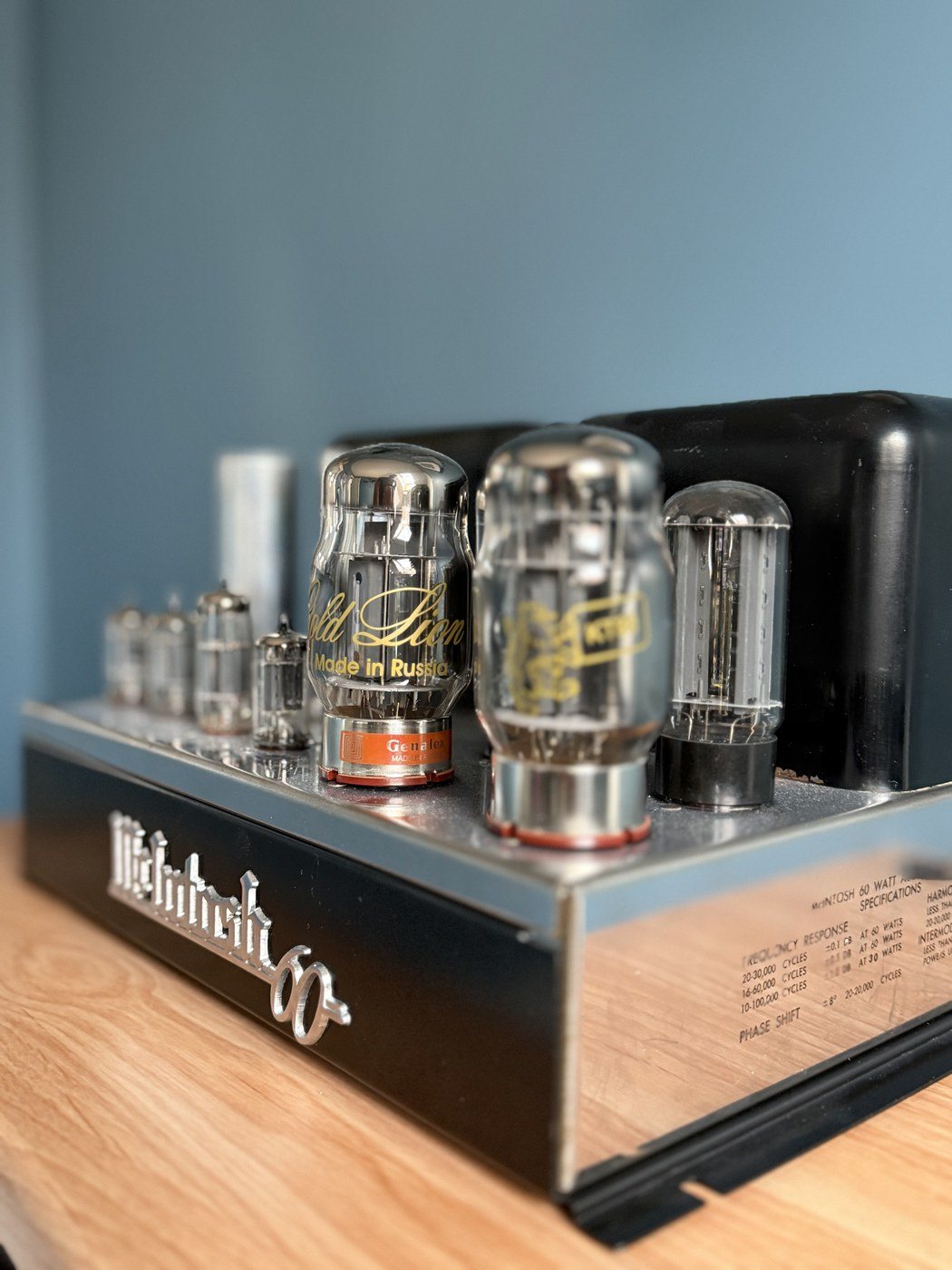
I run a set of fully restored McIntosh MC60 monoblock tube amplifiers as my reference. Rebuilt, rebiased, genuinely excellent. I switched between them and the C33 monitor amp repeatedly across multiple sessions with diverse source material. My consistent preference was the C33. The MC60s carry a tube dimensionality and weight in the lower midrange that is seductive. But the C33 delivers something the MC60s cannot: smoothness and accuracy simultaneously, without the warmth-induced softening that tubes introduce in the upper bass and lower midrange.
The Forte IVs, highly efficient horn-loaded designs that they are, respond particularly well to amplifiers that simply get out of the music's way. Most significantly: after three or four hours of listening, I am not fatigued. The sessions end because of time, not tiredness.
The MA6200 Experiment: Architecture Is Everything
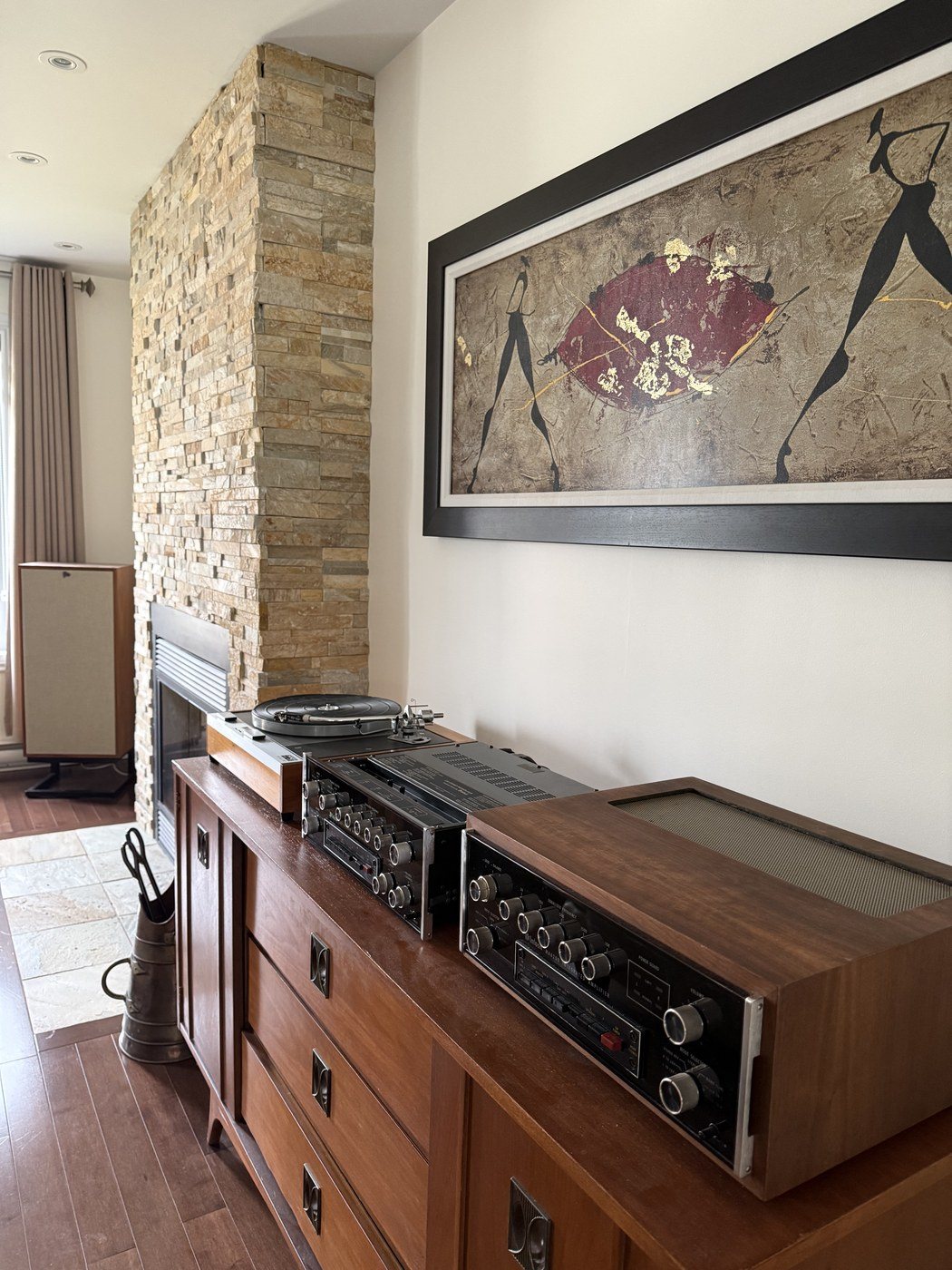
Before settling on the C33 as my reference, I ran a series of structured comparisons using another McIntosh piece I own — the MA6200 integrated amplifier — and what those experiments revealed is the most technically instructive part of this story.
The MA6200 is a fascinating split-personality design worth understanding precisely. Its preamplifier and control section are built entirely on IC op-amp architecture. However, its power amplifier is an entirely different matter: an all-discrete, fully complementary direct-coupled push/pull transistor design — not a single IC anywhere in the power stage. And critically, like all integrated amplifiers McIntosh made, the MA6200 has no autoformer output transformer — a component found only in McIntosh's standalone MC-series power amplifiers.
This split architecture makes the MA6200 a useful and revealing test instrument. I ran three distinct comparisons:
Test 1: MA6200 as a complete integrated amplifier driving the Forte IVs. The MA6200 is a more than capable and smooth-sounding integrated amplifier. But the all-discrete transistor power stage has its own distinct character — a slight warmth and softness in the upper bass that the Forte IV's revealing horn midrange makes immediately audible. Musical, but not fully transparent.
Test 2: C33 as preamplifier connected to the MA6200 power section only. This is where the comparison became genuinely revealing. Even with the C33's demonstrably superior IC preamp section driving it, the MA6200's all-discrete power amp stage reasserted its own character. The slight warmth and upper-bass softness remained unchanged. The transparency the C33 alone delivers was partially obscured — not by the preamp, but by the power stage downstream of it. The conclusion was unambiguous: the power amplifier's architecture was adding colouration that no upstream improvement could remove.
Test 3: C33 monitor amp driving the Forte IVs directly — no external power amp. This produced the most transparent, accurate, and musically satisfying result of the three. With no separate power stage in the circuit, the C33's IC-based signal path ran cleanly from source to speaker without any additional architectural personality being imposed.
A signal chain is only as clean as its least transparent component. Connecting a cleaner preamp to a coloured power amp does not give you the best of both worlds — it gives you the power amp's sound with a cleaner input signal feeding it.
What High-Sensitivity Speaker Owners Should Know
The conventional assumption is that more watts equals better performance. For the Klipsch Heritage family — Forte IV, Cornwall, La Scala, Klipschorn — and other high-efficiency designs like Zu Audio, this assumption deserves serious challenge.
Originally, Klipsch Heritage speakers were engineered for an era when amplifier power was expensive and scarce. What they need is not raw wattage. It is resolution, low noise, low distortion, and control. The McIntosh C33's monitor amplifier delivers all four. Twenty competently executed watts from a pre-Clarion McIntosh IC design is not a compromise. For this application — efficient speakers, moderate listening levels, a priority on musicality and long-session fatigue-free listening — it may well be the optimal solution.
The MA6200 experiments confirmed this from the opposite direction. More power, more architecture, more components in the signal chain did not improve the result. In every comparison, simplicity and quality of execution outperformed complexity and quantity of watts.
What Comes Next: The McIntosh MC2255 Test
The C33 was designed alongside and sold concurrently with the McIntosh MC2255 — the standalone flagship stereo power amplifier of the same era, produced from 1981 to 1986 in exact parallel with the C33. It delivers 250 watts per channel through McIntosh's patented autoformer output stage at a rated THD of just 0.02%. Architecturally and philosophically, it is the period-correct power amp the C33 was designed to drive — built by the same engineering culture, in the same pre-Clarion era, voiced on the same terms.
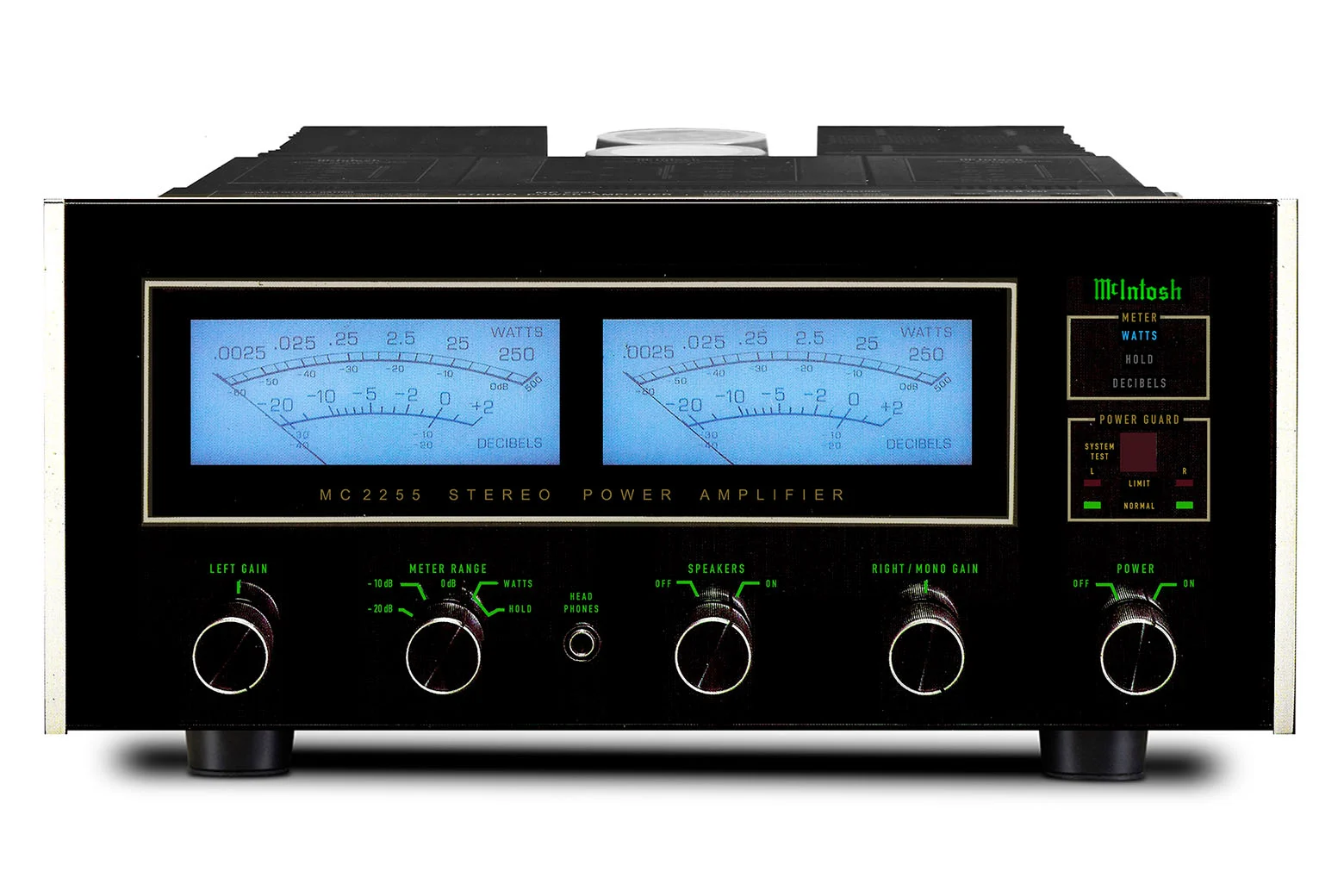
Critically, the MC2255 addresses the one structural variable the MA6200 experiments made clear: the autoformer output stage. Where the MA6200's all-discrete power section presents the speaker's full impedance variability directly to the output transistors, the MC2255's autoformer delivers its full 250 watts into 8, 4 or 2 ohms alike — a stable, consistent load regardless of what the Forte IV's impedance curve is doing at any given frequency. Paired with McIntosh's Power Guard circuitry, which stops the amplifier from ever clipping into distortion, that is a meaningful real-world difference with a speaker as revealing as the Forte IV.
I am sourcing one. The comparison will be direct: C33 monitor amp alone versus C33 as preamplifier driving the MC2255 into the Forte IVs. Whether 250 watts and a proper autoformer output stage fundamentally changes the picture — or whether the 20-watt sweet-spot secret holds its ground — remains to be discovered.
What I already know: the McIntosh C33 has permanently changed how I think about amplifier matching for efficient speakers. It occupies a moment in audio history that produced something genuinely special — IC precision, pre-Clarion soul, and a 20-watt secret hiding in plain sight for forty-five years.