Preface
This is a white paper
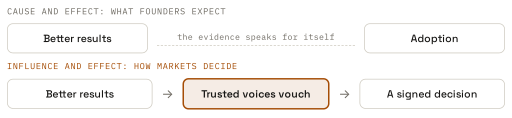
By its own argument, this paper won’t convince you on its own. Buyers don’t adopt disruptive technology because of documents like this one. They adopt it when someone they already trust vouches for it.
So why write one? Because deep tech and AI founders deserve to see the reasoning, and because the people founders already trust (investors, board members, the founders who went before them) need something worth forwarding.
If this paper reached you through one of them, it is already working the way it describes.
Overview
Executive summary
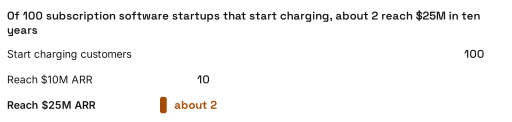
Only one subscription software startup in fifty reaches $25M in annual recurring revenue within ten years of charging its first customer (Growth Unhinged / ChartMogul, 2025), and deep tech’s odds are steeper still. In my experience, many of those with proven technology didn’t lose on the technology. They lost because buyers never trusted them enough to sign.
Founders trained in science, math and engineering usually treat that gap as a technical problem. They add proof, tools, benchmarks and endless dashboard variations. But buyers facing an unknown vendor fall back on the oldest risk system humans have: they trust what people they already trust are willing to vouch for. For AI companies the bar is higher still. Fewer than half of people worldwide are willing to trust AI systems (University of Melbourne and KPMG, 2025). That wariness follows AI into the buying committee: buyers need someone they trust to vouch not just for you, but for the technology itself.
This paper explains that system: where the instinct comes from, how it runs an enterprise buying committee, and why it keeps promising pilots stuck for months, and sometimes years. It then shows the system at work in four cases: from inside two companies where I led marketing, TrueContext (acquired by Battery Ventures) and OptoSecurity (acquired by Toyota’s Vanderlande), and from Flyscan, a long-term deep tech and AI client now ranked 8th on the 2026 Deloitte Technology Fast 50. It ends with a way to test the idea on your own deals in about a month.
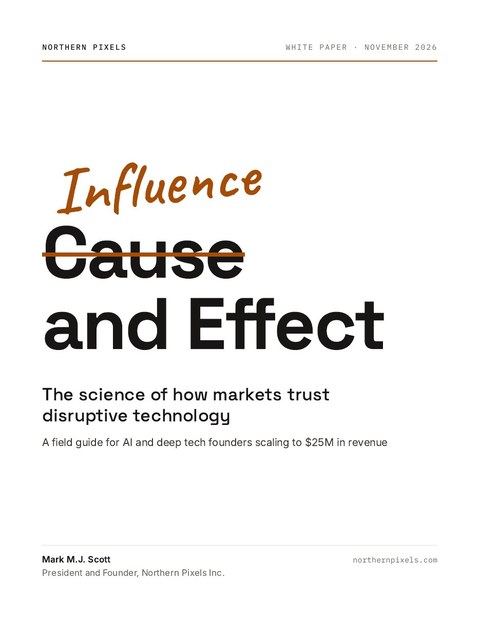
In the lab, results follow cause and effect. In the market, they follow influence and effect.
Section 01
The hardest $25M
The climb from first customer to $25M in revenue is where most startups stall, and it is exactly where trust is scarcest.
1 in 200
deep tech startups survive to Series C, against about one in 55 for other tech.
Our arithmetic on BCG, 2023
1 in 50
subscription software startups reach $25M ARR within ten years of first charging customers.
Growth Unhinged / ChartMogul, 2025
Boston Consulting Group’s November 2023 report An Investor’s Guide to Deep Tech sets out the odds for deep tech plainly. Deep tech startups fail more often than other tech startups at every funding stage, and take up to about 40% longer between rounds: roughly 95 months from seed to Series D, against 75 for other tech.
| Funding stage | Failure rate, deep tech | Failure rate, other tech | Months between rounds, deep tech | Months between rounds, other tech |
|---|---|---|---|---|
| Seed to Series A | ~95% | ~90% | 20 | 15 |
| Series A to B | ~80% | ~70% | 24 | 17 |
| Series B to C | ~50% | ~40% | 25 | 20 |
| Series C to D | Varies by venture | Varies by venture | 24 | 23 |
Source: BCG, An Investor’s Guide to Deep Tech (2023), Exhibit 5. BCG defines failure as a company ceasing operation. Failure rates are BCG’s approximations.
Compounded, BCG’s approximate rates imply that roughly one deep tech startup in 200 survives to Series C, against about one in 55 for other tech (our arithmetic).
Revenue tells the same story. Kyle Poyar’s analysis of 6,525 subscription software companies found that about one in ten reaches $10M in annual recurring revenue, and one in fifty reaches $25M within ten years of first charging customers. That is worse than the admission odds at Harvard or Stanford, and deep tech’s longer, riskier road is unlikely to improve them.
The reward at the end is the same: BCG found almost no difference in returns between deep tech and traditional venture funds. The road is simply longer and more dangerous, and in my experience the bar is higher still for category-disrupting AI and deep tech.
Why this stretch is different
Every startup begins with a trust deficit. Before $25M you have few references, little analyst coverage, no installed base and no history of being the safe choice. Each buyer you approach is among the first to put their name on you. Past $25M, references exist and buyers can point to peers who went first. That is why this paper is about the early stage, when there is nothing yet to lean on.
The investors see it too
The venture firms that back these companies increasingly describe the problem in trust terms. In February 2026, a16z ecosystem partner David Booth published The Lighthouse Playbook. His diagnosis: an early company faces a credibility gap every time it tries to attract customers, talent, capital or partners.
“Every conversion requires trust that hasn’t been earned yet.”
His prescription is to borrow it: find the respected people your audience already trusts, make them more visible and more successful, and let trust transfer from them to you. Marc Andreessen calls top-tier investor backing “a bridge loan of credibility.”
A bridge loan has to be repaid. Investor credibility gets you meetings; it does not get an enterprise buying committee to sign.
The rest of this paper explains why, and how founders who reached $25M turned borrowed credibility into trust of their own.
Section 02
The category error
Founders who stall before $25M are rarely short of intelligence or evidence. They are applying the scientific method to a problem it doesn’t govern. Most deep tech and AI founders I work with can explain their technology to me in under ten minutes. Almost none can explain why their best prospect still hasn’t signed a purchase order.
The trait is the entry ticket
Start with what is right about the scientific mind. The analytical rigor and the stubbornness that come with founding AI and deep tech are the price of admission. A founder who could be talked out of the idea would have been, years ago. I could not have built what most of my clients have built.
The trap
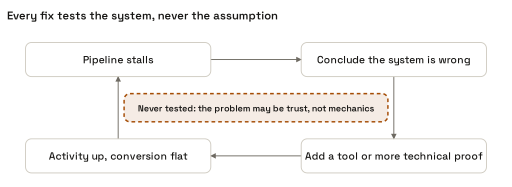
The same operating system, pointed at the market, produces a loop. Pipeline isn’t converting, so the system must be wrong, so find a better system. Every variable gets tested except one: the assumption that the problem is mechanical, that a better process, tool or proof point will fix it.
That assumption isn’t in the hypothesis set. It is the lens the testing runs through.
The proof default
Buyers hesitate, so add another benchmark, another decimal place, a deeper technical paper.
The tooling default
Pipeline is thin, so engineer the funnel: AI sales agents, intent data, automated sequencing, a rebuilt CRM. If you build AI, AI feels like the obvious answer to selling it.
The tools are real and necessary, and a company that can’t run a modern pipeline engine shouldn’t expect to scale. But tools multiply what is already there. Pointed at a market that trusts you, they compound. Pointed at a market that has never heard of you, they deliver an unknown name to more strangers, faster. And when every competitor runs the same stack, volume stops setting anyone apart. It just becomes noise.
A stage, not a defect
Markets are not peer-review panels. A reviewer asks whether your result is true. A buyer asks whether she can safely put her name on you. Most founders who win learn the difference. It usually takes years and an expensive stretch of runway: the tuition paid to learn that the market runs on a different science.
This paper’s aim is to make that stretch shorter.
Section 03
Two sciences
In the lab, the result outranks who reported it. In the market, who reported it outranks the result.
That isn’t true of every purchase. It is true when an unfamiliar vendor asks a buyer to make a high-exposure decision, which is exactly the kind of decision this paper is about. The market is not soft. It is a different kind of system, with rules that are just as consistent as the ones in your lab. They simply measure different things.
| In the lab | In the market | |
|---|---|---|
| Who evaluates | One expert, judging merit | A committee, judging personal risk |
| What counts as proof | Reproducibility | Reputation of the source |
| How belief moves | Converges as evidence accumulates | Locks in early and sticks |
| What failure becomes | Data for the next experiment | A story that travels ahead of you |
| Who you need to convince | The person who understands the work | People who never will |
The last row is the hardest one. A CFO cannot assess your architecture. She can assess whether people she respects are vouching for you. Performance gets you into the conversation. Conferred trust gets you the signature.
Ancient wiring: why the unknown reads as a threat
Wariness of the unfamiliar is one of the oldest and best-documented features of human behavior. Your buyers didn’t learn it in business school. They were born with it.
Stranger anxiety
Infants begin showing wariness of unfamiliar adults at around six to nine months, across cultures. Caution about strangers appears before language does.
The smoke-detector principle
Nesse showed why defenses over-react. A smoke detector that sounds for burnt toast is annoying; one that stays silent in a fire is fatal. When one mistake costs far more than the other, evolution favors the cheap error. Haselton and Buss formalized this as error management theory.
The mere-exposure effect
Zajonc found that familiarity alone increases liking. An unknown vendor starts at a deficit before anyone has looked at the data.
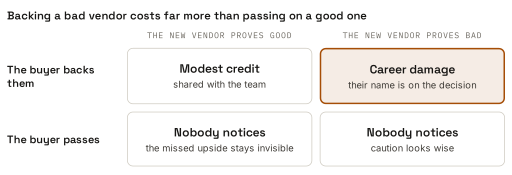
A buyer who says “let’s wait for references” or “let’s extend the pilot” isn’t being irrational. They are applying an old, reliable survival rule to a career decision.
The founder’s task is not to argue with the instinct. It is to supply what the instinct is looking for.
Section 04
How humans learned to trust strangers anyway
Humans never overcame their distrust of strangers. They built networks that vouch for strangers. Conferred trust is the workaround that evolution and culture produced, and it is the hinge of this paper.
Monkeys track the source
Cheney and Seyfarth repeatedly played one vervet’s alarm call when no predator was there. Listeners learned to discount that animal’s false alarms while still heeding others. Primates judge the caller, not just the call.
Costly signals carry weight
Zahavi and Spence showed that signals are believed when they are expensive to fake. A founder’s own claim costs nothing; a respected third party staking their reputation on you costs a great deal.
Merchants without courts
Greif’s 11th-century Maghribi traders relied on agents they could never watch, held together by a coalition that shared who could be trusted and who had cheated.
Trust passes from someone already trusted to someone new, and it moves only as far as the voucher is willing to stake their own reputation.
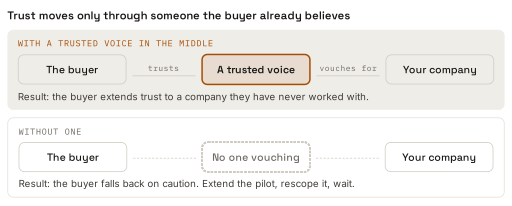
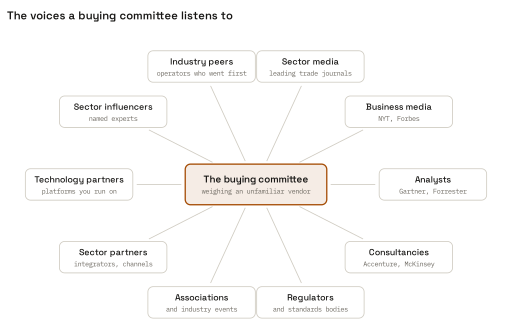
One trusted voice opens the door. Most buying committees listen to several, and Figure 6 maps the ones that matter most.
Case
OptoSecurity: building the trust chain on purpose
- Situation
- Optical imaging combined with an early machine-learning engine to identify threats in baggage, for civil aviation security: highly regulated, slow to adopt, and run by buyers whose careers end with one wrong call.
- Trust gap
- No regulator, airport or security director wanted to be first to trust a new detection technology from a company they had never heard of.
- What we did
- We mapped the voices that shaped opinion in aviation security, then built a coordinated plan to earn support across all of them at once.
- Who vouched
Specialist validation: the civil aviation technology editor of Jane’s spent two days at headquarters, which led to a two-page solution feature.
Broad familiarity: Discovery Channel’s Future Weapons showed millions of viewers the product at work.
Public and policy reach: a New York Times article brought the debate about outdated, vulnerable security to the public and to politicians.
- Outcome
- OptoSecurity’s team built an early machine-learning detection system; our work put it in front of the people the industry listens to. The company became an emerging category leader and was later acquired by Vanderlande, part of Toyota Industries.
“Mark Scott was instrumental in shaping our foundational marketing strategy and catapulting us onto the global stage.”
Section 05
The buying committee: the same instincts, with job titles
An enterprise purchase of disruptive technology is not one decision. It is several people each deciding whether this vendor could damage their career, and the ancient instincts from Section 3 run every one of those decisions.
Losses weigh more than gains
Kahneman and Tversky’s prospect theory shows people feel a loss roughly twice as strongly as an equal gain. Your upside is a line in a business case. The downside is a name attached to a failure.
Accountability favors the defensible
Tetlock found that people who expect to justify a decision choose the option easiest to defend, not the best one. That is the old line about buying IBM, explained.
The status quo wins ties
Samuelson and Zeckhauser documented a strong bias toward keeping the current option, even when the alternatives are just as good.
Current B2B research agrees: LinkedIn’s B2B Institute and Bain & Company find that buyers weigh whether they can defend a choice as well as whether it works, and that trusted recommendations can outweigh price or product claims (Buyability, 2026; Sutherland, 2020).
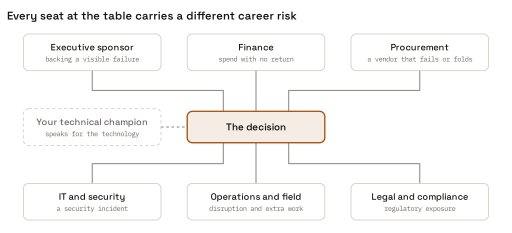
The committee’s risk ledger
| Role | Career risk they carry | The voice that lowers it |
|---|---|---|
| Executive sponsor | Backing a visible failure | Peer executives who have done it |
| Finance | Spend with no measurable return | Documented results at a comparable company |
| Procurement | A vendor that fails or folds | References, strong backers, industry press |
| IT and security | An integration or security incident | Integrators, platform partners, IT peers |
| Operations and field | Disruption and extra work | Front-line users in a similar operation |
| Legal and compliance | Liability and regulatory exposure | Regulators, standards bodies, insurers |
Your technical champion can answer almost none of these. Each row needs a different voice.
The obstacle is the same whether you are creating a new category or challenging an incumbent: in one there is no safe choice yet, in the other the incumbent is the safe choice.
Category leadership is not a strategy. It is what happens once enough buyers trust you.
Case
TrueContext and Johnson Controls: turning one champion into an organization
- Situation
- TrueContext’s mobile field platform had a proof of concept and limited deployments at Johnson Controls, championed by a mid-level manager. A global rollout needed buy-in from every layer, and field teams saw it as one more product they were being told to use.
- What we did
- We helped the champion build the story of their own success: speaking slots at industry conferences, published case studies, and an in-depth video they could take to Johnson Controls branches around the world.
- Who vouched
- Johnson Controls’ own people: field staff, field IT, field management, directors and the C-suite, each describing how the technology was changing their part of the business.
- Outcome
- Reluctance turned into demand from inside the company. Field teams went from “another new product to use” to wanting what their peers already had.
Section 06
Pilot purgatory, explained
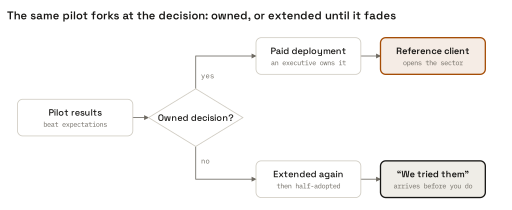
The most frustrating trap in deep tech is the pilot with a marquee customer that never converts. It looks like progress: a name-brand logo for the investor deck, a technical team that loves you, and results that beat what anyone expected. Then month six becomes quarter four becomes year three. The pilot gets extended, rescoped, “socialized internally.” It never turns into a paid relationship.
Founders read this as a sign they need more proof. Usually the proof landed months ago. This is not a rare problem: MIT’s NANDA research found that only about 5% of task-specific enterprise AI systems it examined reached production, and blamed implementation and projects without accountable business owners, not model quality. The report was preliminary, so read it as a sign of scale, not a precise rate.
Your champion shares your blind spot
Look at who runs your pilot. Usually it is your own tribe: technically curious, scientifically minded, excited by what your product can do. They share your belief that performance outweighs everything, and they expect great results to convince their C-suite to bet on an unknown company. But that bet runs through the committee in Section 5, and each member is weighing their own career risk.
Your champion is bringing a data sheet to a trust fight. So are you.
Geoffrey Moore described the pattern in Crossing the Chasm: early adopters buy on vision, but the pragmatic majority buys only on references from other pragmatists. Your champion is a visionary trying to sell your product to pragmatists, armed only with results.
The final turn of the knife
Sometimes the pilot does convert, into a deployment nobody really owns. That is the costliest mistake of all. It is under-resourced, partly integrated, and never championed beyond the original technical team. Predictably, it underperforms. A failed deployment of an unfamiliar technology can end the career of the champion who backed it, and every buyer knows it.
The technology didn’t fail; the adoption did. But that distinction never travels. What travels is “we tried them, it didn’t work out.”
Section 07
The objections a rigorous reader should raise
A paper that asks scientists to accept its argument should test that argument the way they would. Here are the four strongest objections, and what the evidence says.
“Press coverage is vanity”
Much of it is. A funding announcement that quotes only the founder and the investor tells a buyer very little: both of them gain if the story is believed.
Sector media works differently. In conservative, regulated industries, the leading trade journal is where buyers go to see what their peers are doing and who has already gone first. Prestige isn’t the test; relevance is. The right voice is the one your buyer already listens to.
The question isn’t whether you’re covered, but who stands next to you in the story.
A startup quoted alone is a vendor making claims. The same startup appearing alongside established industry names, with buyers’ peers speaking on the record, borrows their credibility.
“AI will make buying rational”
TrustRadius’s 2026 survey of 1,862 technology buyers found that 63% used AI in their purchase journey, and 94% of them fact-check what it tells them at least some of the time. Fact-checking is a search for corroboration from someone trustworthy, and AI recommendations draw heavily on trusted third-party content.
When anyone can produce a convincing white paper in an afternoon, the source becomes the only thing that can’t be generated.
“My problem might not be trust”
It might not be. Trust can’t rescue a weak business case, a product that doesn’t fit the workflow or a market that doesn’t feel the pain yet. Some markets don’t run on trust at all: a16z’s Lighthouse or Landgrab? argues that when a mistake won’t cost the buyer their job, speed and ROI math beat social proof. This paper is for founders whose buyers carry real personal exposure. The pattern in your deals usually tells you which constraint you face.
| What you’re seeing | Most likely constraint | Look here first |
|---|---|---|
| Deals stall after the technology is proven | Trust, sponsorship or decision ownership | Who owns the decision, and whose word they need |
| Pilots succeed but never become contracts | Decision ownership | Exit criteria and an executive owner, agreed before day one |
| Prospects don’t see why they need you now | Positioning and urgency | Your ideal customer profile and the problem you lead with |
| Buyers agree on the value but reject the price | Economics | ROI, budget and willingness to pay |
| Customers buy, but rollouts disappoint | Delivery | Implementation, integration and customer success |
| You win through founder relationships but can’t scale beyond them | Trust that doesn’t travel without you | A network of voices that vouch when you’re not in the room |
Where trust is the constraint, the rest of this paper applies. Where it isn’t, fix the real constraint first.
“Your cases are success stories”
They are, and a careful reader should discount them for it. None of them can show how much of the result came from trust and how much from the product, the timing, the team or the market. That is survivorship bias, and adding more stories wouldn’t remove it. In every case, the founders’ technology and the commercial team’s selling were the foundation. Our work was built to work alongside them, not instead of them.
What the paper can claim is narrower. The research in Sections 3 to 5 supports the behavioural mechanisms behind this framework. The cases illustrate how those mechanisms operate in commercial settings, in regulated and conservative markets, across two decades. Neither establishes the size of the effect in your company.
So don’t take it on faith. The test at the end of this paper shows how to start testing it on your own deals in about a month.
Section 08
Measure it, then design for it
The usual objection to “trust” in go-to-market is that it is vague. A rigorous mind is right to reject most of what is sold as buyer psychology. The error is concluding that because the available answers are soft, the problem is soft.
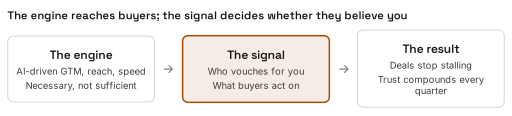
Trust in your company behaves like an asset with observable properties: inputs you can list, a build time, a decay rate when neglected, and a compounding curve once it starts working. The voices that move deals in a given sector are a finite, countable list.
For each one, there is a simple quarterly test: will they say your name, unprompted, to a buyer who asks?
| The engine: pipeline metrics | The signal: trust metrics |
|---|---|
| Leads and meetings booked | Named voices in your sector who vouch for you unprompted |
| Conversion rate by stage | Buying-committee roles with a credible voice behind you |
| Sales cycle length | Live pilots with an executive owner and an agreed decision date |
| Win rate | References willing to take a call, by sector |
| Share of voice in your own channels | Independent mentions in sources buyers and AI systems rely on |
You need the pipeline engine and the metrics under it. But the engine harvests demand; it doesn’t decide who buyers trust. Treat the right-hand column as leading indicators, not proof: track them alongside your pipeline stages and check, account by account, whether deals with credible voices behind them progress faster. Within two or three quarters, your own data will show you which voices count in your market.
No one owns influence
By the time a company is on its way to $25M, the go-to-market machinery is usually in place. Marketing runs campaigns, events, content and automation. Sales works the pipeline. Customer success manages accounts. These are table stakes, and good teams run them well.
What’s usually missing isn’t another activity. It’s ownership.
No one is responsible for deciding which voices your buyers listen to, why those voices would speak up for you, and how their influence reaches the deals that matter. Four moves close the gap.
01
Map the buying committee like a system architecture
For every target account, name each role, its career risk and the voice that would lower it, starting from the circle of voices in Figure 6. Treat a missing voice the way you’d treat a missing component.
02
Build the vouching network before the pilot starts
Integrators, respected operators, industry bodies, sector media and the advisors buyers quietly call. Make them more visible and more successful. When you earn coverage, design who stands next to you in it.
03
Design pilots that end in a decision
Agree exit criteria with the C-suite before day one, name an executive owner, and set a date for the decision. A pilot without an owner is an experiment with no one waiting for the result.
04
Let go-to-market expertise lead
For brilliant founders this is the hardest step. Almost anyone can run a marketing stack today. What’s scarce is knowing where to point it and what to say. The cost isn’t the expertise; it’s the years spent learning this science alone.
Case
Flyscan: changing who tells the story
- Situation
- Flyscan uses AI-powered hyperspectral and digital camera remote sensing to inspect oil and gas pipelines from the air, detecting threats in real time and leaks invisible to the human eye. Pipeline operators are regulated and conservative, and right-of-way integrity is too critical to hand to an unproven supplier.
- What we did
- We mapped the individuals, organizations, brands and publications that shape how operators judge new technology, and shifted the company’s story from innovation to outcomes.
- Who vouched
- Sector leaders, describing their own results in leading industry publications, on panels and in case studies. Leading pipeline operators are also among Flyscan’s clients and investors, won through Flyscan’s own sales and investor meetings.
- Outcome
- On October 28, 2026, Flyscan ranked 8th of 50 on the Deloitte Technology Fast 50, with revenue growth of 5,465% from fiscal 2022 to 2025 (Deloitte, 2026; Flyscan, 2026). That growth belongs first to Flyscan’s team: its engineers and scientists built something remarkable, and its leaders won sales and investment through many flights, hotel stays and in-person meetings. We added a different kind of expertise to theirs, so that Flyscan’s name arrived before its people did.
8th of 50
Deloitte Technology Fast 50, October 2026
5,465%
revenue growth, fiscal 2022 to 2025
Seven voices, one pattern
| Trusted voice | The committee fear it answers | Example |
|---|---|---|
| Industry clients and investors | “Will the leaders in our industry back them?” | Leading pipeline operators became clients and investors (Flyscan) |
| Industry analysts | “Is this vendor safe to put my name on?” | Gartner named the company its enterprise category leader (TrueContext) |
| Customer champions | “Has this worked somewhere like us?” | Johnson Controls’ own people, from field staff to the C-suite (TrueContext) |
| Platform partners | “Does it fit what we already run?” | Apple’s program partner team named it the best B2B co-marketing partner (TrueContext) |
| Channel partners | “Who stands behind them?” | AT&T, then Microsoft (TrueContext) |
| Trusted advisors | “What do our advisors say?” | Global consultancies, financial institutions and quantum zones reviewed the zone’s strategy before submission (DistriQ) |
| Specialist, trade and national media | “Have we ever heard of them?” | Jane’s, Discovery Channel, The New York Times (OptoSecurity); Pipeline & Gas Journal (Flyscan) |
Section 09
Replaying the pilot
Go back to the pilot in Section 6: a marquee customer, a technical team that loves you, results that beat expectations. Now run it again with the trust work done. Same technology. Same pilot. Different ending.
I joined TrueContext as founding head of marketing when it had 12 employees and under $500K in annual recurring revenue. It grew past $30M and was acquired by Battery Ventures, powered by a product, sales and customer team I was proud to work alongside. My part was the job this paper is about: getting the voices buyers already trusted speaking for the company. That is why TrueContext appears so often in this paper: on its way to $30M, it used most of the trusted voices described here.
Case
Shell: from local pilots to a global agreement
- Situation
- TrueContext’s proofs of concept and small deployments at Shell in Canada, in the United States, and on Prelude, the world’s largest floating liquefied natural gas platform. The results were strong, but Shell’s innovation champions had no way to show their value to global leadership. Each pilot was a local success the rest of the company never heard about.
- What we did
- We made those champions the priority. We helped each of them build the story of their own results, with the Prelude deployment at its center, and publish it inside Shell through success stories, internal webinars and video, distributed to global leaders and innovation teams.
- Who vouched
- Shell’s own people: engineers and managers from three regions, describing outcomes they had seen themselves, to colleagues who trusted them.
- Outcome
- Shell signed a global master services agreement. TrueContext’s product and sales teams earned the pilots; the marketing work gave Shell’s champions the means to speak for TrueContext when TrueContext wasn’t in the room, carrying those results to global leadership. The story then became a beachhead into the wider energy market.
Same technology. Same pilot. Different ending.
| The pilot in Section 6 | The replay | |
|---|---|---|
| Who told the story | The vendor | The customer’s own people |
| Who heard the results | The team that ran the pilot | Global leaders and innovation teams |
| What the decision rested on | A data sheet | Colleagues the committee already trusted |
| What the market heard | “We tried them” | A global agreement |
The technology didn’t change. What changed was who told the story, who heard it, and whether the organization could act on it.
Close
In the lab, your peers reviewed the work.
In the market, your buyers’ peers review you.
For your leadership team
Test it on your own deals
This paper makes a claim you can test. Here is how to do it in about a month, with your own team and your own pipeline.
Step 1 · Week 1
Look back
Review five stalled deals and three recent wins. For each, write down who owned the decision, which objections remained, what happened after the technology was proven, and whose word the buyer relied on. Then ask:
- If our best pilot ended badly tomorrow, what would the market hear, and from whom?
- Which customers would take a reference call for us this week?
- Are we adding tools or proof to fix a problem that is really about trust?
Step 2 · Week 2
Map one live opportunity
Choose your most important open deal. Name each person on the buying committee, what they risk, and the voice that would lower that risk (Section 5 and Figure 6). Ask your champion directly what is holding the decision back. Don’t assume the answer is trust. Then ask:
- Who outside our company is vouching for us to our next three target buyers?
- On this account’s buying committee, which credible voice stands behind us for each role?
- Which integrators, operators or industry bodies would say our name unprompted today?
- Where do buyers, and the AI tools they use, find independent evidence about us, and what does it say?
Step 3 · Weeks 3 to 4, then track it
Run one intervention
If the evidence points to a credibility gap, bring in the single most relevant voice: a customer reference, a partner or a respected operator. Agree on an executive owner and a decision date. Treat the four weeks as an early read: measure how quickly you reach the economic buyer, how many objections stay open, who owns the decision and whether the deal moves forward. Then track pilot conversion and revenue over your normal sales cycle. Before you start, ask:
- Does every live pilot have an agreed path to a purchase decision, and an executive who owns it?
- Beyond our champion, who inside the customer has heard the pilot’s results?
- Is our champion equipped to tell the story to people who will never understand the technology?
Step 4 · After week 4
Read the results
A month is an early read, so mixed or unclear results are normal. If the results are uncertain, or you’d like a second opinion on what you find, I’m glad to talk it through.
If nothing moves, revisit the diagnosis: you may be facing a different constraint, or you chose the wrong voice. If something does, you’ve found your lever.
About
About the author
Mark M.J. Scott is President and Founder of Northern Pixels Inc. He led marketing inside three tech startups, all of which exited: OptoSecurity (acquired by Toyota’s Vanderlande), TrueContext (acquired by Battery Ventures) and Zero-Knowledge Systems (acquired by AppDirect). At TrueContext, he led marketing as the company grew from under $500K to $30M in annual recurring revenue.
Long-term client Flyscan, an AI-powered aerial pipeline integrity company, ranked 8th on the 2026 Deloitte Technology Fast 50, with revenue growth of 5,465% from fiscal 2022 to 2025. In 2023, on a six-month contract, he served as Chief Marketing Officer to DistriQ, Quebec’s Quantum Innovation Zone, backed by more than $435M in public and private commitments.
Northern Pixels works with AI and deep tech founders scaling to $25M. Mark designs and activates the influence strategy that connects a company’s existing go-to-market engine to the voices that shape buying decisions, stepping in as CMO where that leadership is missing, with a team that executes and his own weekly involvement.
mark@northernpixels.com · northernpixels.com
Sources
References
Market and investor sources
- Booth, D. (2026, February 12). The Lighthouse Playbook. Andreessen Horowitz.
- Booth, D. (2025, October 22). Joining a16z: Preferential attachment, turning VC into a network effect business. Andreessen Horowitz. Source of Marc Andreessen’s “bridge loan of credibility” remark, from the Cheeky Pint podcast.
- Schmidt, J. and Marx, J. (2026, July 27). Lighthouse or Landgrab? How to Pick Your AI Sales Strategy. Andreessen Horowitz.
- Poyar, K. (2025, October 15). The odds of making it. Growth Unhinged, with ChartMogul data on 6,525 subscription software companies.
- University of Melbourne and KPMG (2025, April 29). Trust, attitudes and use of artificial intelligence: a global study 2025. Melbourne Business School.
- Bobier, J.-F., Coulin, A.-D., Morez, C., Emerson, G., Wagle, K. and Gourévitch, A. (2023, November). An Investor’s Guide to Deep Tech. Boston Consulting Group.
- LinkedIn B2B Institute and Bain & Company (2026). Buyability. LinkedIn B2B Institute.
- Sutherland, R. (2020). The Objectivity Trap: On the biases and misconceptions that cause us all to undervalue B2B marketing. LinkedIn B2B Institute.
- Scott, M. J. (2026, March). AI-powered ROW intelligence transforms pipeline integrity across land, air and space. Pipeline & Gas Journal, 253(3).
- Deloitte (2026). 2026 Technology Fast 50 program winners. Deloitte Canada.
- Flyscan Systems (2026, October 28). Flyscan ranks No. 8 in Deloitte’s 2026 Technology Fast 50 program. Flyscan.
- TrustRadius / HG Insights (2026, July 15). 2026 B2B Buying Disconnect Report: press release.
- MIT NANDA (2025). The GenAI Divide: State of AI in Business 2025 (preliminary), as summarized by Let’s Data Science.
Behavioral and evolutionary science
- Cesario, J., Johnson, D. J. and Eisthen, H. L. (2020). Your brain is not an onion with a tiny reptile inside. Current Directions in Psychological Science, 29(3), 255–260.
- Cheney, D. L. and Seyfarth, R. M. (1988). Assessment of meaning and the detection of unreliable signals by vervet monkeys. Animal Behaviour, 36(2), 477–486.
- Greif, A. (1989). Reputation and coalitions in medieval trade: evidence on the Maghribi traders. Journal of Economic History, 49(4), 857–882.
- Haselton, M. G. and Buss, D. M. (2000). Error management theory: a new perspective on biases in cross-sex mind reading. Journal of Personality and Social Psychology, 78(1), 81–91.
- Kahneman, D. and Tversky, A. (1979). Prospect theory: an analysis of decision under risk. Econometrica, 47(2), 263–291.
- Moore, G. A. (1991). Crossing the Chasm. HarperBusiness.
- Nesse, R. M. (2005). Natural selection and the regulation of defenses: a signal detection analysis of the smoke detector principle. Evolution and Human Behavior, 26(1), 88–105.
- Samuelson, W. and Zeckhauser, R. (1988). Status quo bias in decision making. Journal of Risk and Uncertainty, 1(1), 7–59.
- Spence, M. (1973). Job market signaling. Quarterly Journal of Economics, 87(3), 355–374.
- Tetlock, P. E. (1983). Accountability and complexity of thought. Journal of Personality and Social Psychology, 45(1), 74–83.
- Tversky, A. and Kahneman, D. (1992). Advances in prospect theory: cumulative representation of uncertainty. Journal of Risk and Uncertainty, 5(4), 297–323.
- Zahavi, A. (1975). Mate selection: a selection for a handicap. Journal of Theoretical Biology, 53(1), 205–214.
- Zajonc, R. B. (1968). Attitudinal effects of mere exposure. Journal of Personality and Social Psychology, 9(2, Pt. 2), 1–27.